01
Secondary research
Industry adoption reports, AI training literature, and a stakeholder session with the CGI consultant who'd developed the foundational behavioral framework.
Desk + sponsor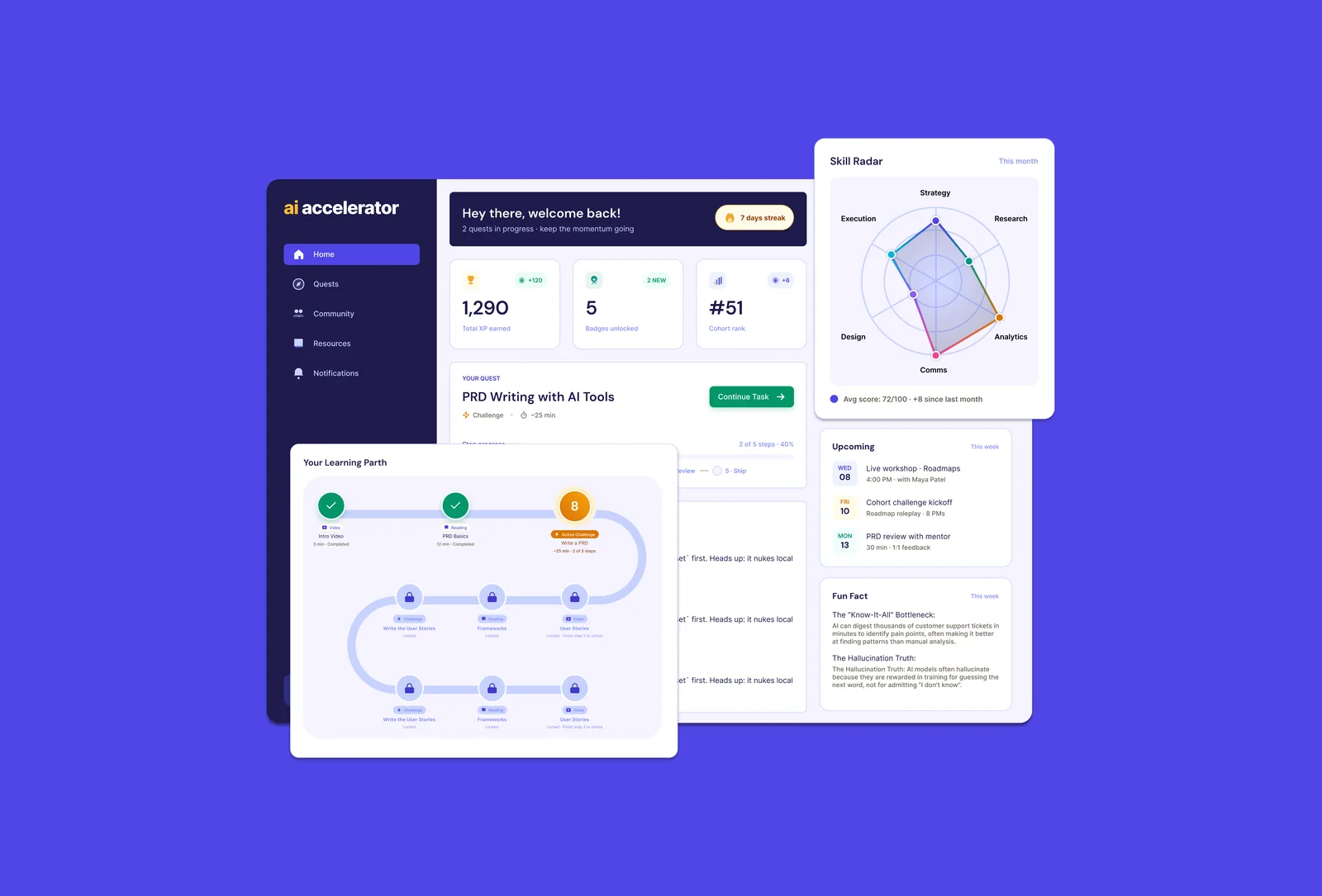
I led a 5-person cross-functional team as a part of my capstone project at Northwestern University sponsored by CGI to design an AI adoption platform that turns AI learning from a mandated training into a workflow habit. End-to-end ownership across research, product strategy, design, and business model. Drove 70%+ sustained user adoption in pilot, shipped to development the week after final delivery.
Due to NDAs with CGI, some specific product details, exact metrics, and internal process names have been generalized or omitted.
Context
Despite widespread investment in AI tools across enterprises, adoption stays low. The signals show up everywhere once you look:
The core gap isn't access to AI tools. It's sustained, effective adoption. Most existing solutions treated this as a training problem. We saw it as a behavioral one.
Research
We started where the assumptions lived: industry articles, adoption-trend reports, and a stakeholder session with the CGI consultant developing the underlying framework. That grounded our hypotheses before we talked to anyone.
Industry adoption reports, AI training literature, and a stakeholder session with the CGI consultant who'd developed the foundational behavioral framework.
Desk + sponsorFive working professionals across industries via DScout. Goal: understand the real barriers to AI adoption, not the assumed ones.
5 generalistsSix professionals piloting a manual, fragmented version of a similar solution. Split evenly between high and low-engagement users.
6 pilot users
Going in, we assumed the barrier was resistance to AI. Research showed something different. Users were curious and willing, but time-constrained. The tools didn't give them a reason to return after first use because they weren't embedded in day-to-day work.
Getting users to start at all was the first failure point. Whatever came before "try the tool" was already losing them.
"I keep meaning to log in. I just never get to it during the workday."
R1 Participant · Marketing
Initial novelty faded fast. AI learning became another competing task, not part of the workflow.
"It started feeling like another mandatory training. I dropped off."
R2 Participant · Engineering
Users who stuck around were driven by practical utility and social validation, not incentives or mandates.
"I kept using it because it actually helped with the report I was writing."
R2 High-engagement user
Most existing solutions treated this as a training problem. We saw it as a behavioral one.
Research-driven personas
From the interviews, three distinct archetypes emerged, not demographic segments, but behavioral patterns based on how people relate to AI at work. Each one maps to a different failure mode of existing training.
Senior Product Manager
Training is built for beginners. I'm not a beginner.
Design implication Role-specific quests tied to real PM workflows. Peer recognition as motivator.
Product Designer
Too many options. No clear starting point.
Design implication Gentle onboarding, small first tasks, peer activity visible by default.
Senior Backend Engineer
Prompt Engineering 101 is beneath me.
Design implication Leaderboards, harder challenges, visible mastery progression.
How each archetype bounced off existing training
Research synthesis
Hundreds of sticky notes clustered into five themes: Participants, Onboarding, Learning, Motivation, and System. The synthesis surfaced one through-line, existing training treats everyone the same, in a domain where everyone is different.

Affinity board from research synthesis · adapted from the original session notes.
The solution
Three principles that shaped every decision
Never say "learn AI." Say "be the PM who brought the angle nobody else thought of." When a task aligns with identity, compliance becomes desire.
Two PMs can have completely different learning styles and motivations. Role is one input. Learning style, motivation, encouragement, and skill level are equally important.
Course completion is a vanity metric. The only metric that matters: did people actually change how they work? Every design decision must create data that answers that question.
The platform sits on CGI's AI Adoption Framework, which fuses habit psychology, behavioral science, and gamification. The framework lets us meet employees where they are, instead of forcing another mandated training on them.
Where habit psychology, behavioral science, and gamification overlap
How do we translate this behavioral framework into a product employees would genuinely want to open, inside their daily workflow, rather than another mandated training tool?
The platform is a centralized, role-specific dashboard integrating learning journeys, tool access, social validation, and performance tracking, all informed by behavioral science.
Profile each user across 6 psychological dimensions before they start.
Role-specific. No generic AI 101 detour for someone who already uses Copilot.
Daily, role-tailored AI tasks that fit inside actual work, not on top of it.
Peer validation and visibility. The retention engine.
Drop-off happened on day zero and weeks three through six. We prioritized the onboarding and challenge loop as MVP focus, going deep on the one thing users interact with every single day rather than spreading effort across all four layers. Retention beats completeness when the system fails to sustain engagement past the first month.
We ran a card-sorting exercise with 5 engineers and designers from CGI's pilot program before making any IA decisions. Users consistently grouped the experience around two things: a command center for getting things done, and a social layer for learning from peers.

That mental model shaped MVP structure directly: Home for high-level progress and training, Profile as the launchpad to every licensed AI tool. We built the structure users already had in their heads.
Key flows
Competitor analysis showed most existing tools offered one-size-fits-all experiences, which fail to sustain engagement. People differ in how they learn, what topics interest them, and how they respond to change.
So we designed personalization across two dimensions:
Core features
Every feature reads from the same behavioral profile: role, learning style, motivation type, encouragement preference, and skill level. The product surfaces what each person needs without ever asking them to configure it.
Five-question onboarding that maps role, learning style, motivation, encouragement, and goals. Under 10 minutes, no configuration.
The system generates a unique trajectory per person and adapts weekly based on completion speed, reflection quality, and engagement.
Real tasks in the user's actual workflow, framed by archetype. Identity over instruction, every time.
Six dimensions tracked over time. Visible, measurable growth week over week, weighted heavier for advanced users.
What teammates are trying, completing, and sharing. The social proof layer that turns frozen users into doers.
For L&D leaders. Behavior change metrics, team adoption rates, exportable reports. The buyer answer to "what did we get?"
Information architecture
Interviews surfaced one structural truth: employees and L&D leaders think about the same product in opposite ways. Employees think in growth; leaders think in outcomes. The IA had to serve both without compromising either.
To validate the split, we ran card sorting with 12 participants on one persistent disagreement: where should leaderboards, badges, and XP live? A dedicated Achievements tab felt disconnected from the work. Scattered across every screen felt noisy. The placement that won was contextual, XP on the dashboard, badges at quest completion, leaderboard in Community, so each element appears at the moment of relevance.
The shipped IA reflects both mental models. Employees navigate by growth (Home, Path, Quests, Community). L&D leaders get their own surface (Admin) without polluting the employee experience.
Personalized dashboard, active quest, peer activity, upcoming events.
Individual trajectory, skill radar across six dimensions, upcoming challenges.
Task library, filtered by role, skill level, and quest type.
Peer discussions, mentor threads, team activity, leaderboards.
L&D-only proof dashboard. Behavior change metrics, adoption rates, exportable reports.
User flow
The returning-user flow is the spine of the product. The notification provides the prompt, the dashboard provides motivation, and the quest provides ability. Fogg's three-factor model in product form.
Weekly engagement loop · adapted from production flow diagrams.
Wireframing exercise
Each fidelity served a different purpose. Paper sketches eliminated layout candidates. Grayscale Figma evaluated structure without visual distraction. Hi-fi tested the real Carbon-styled experience.
12 dashboard layouts sketched in a single afternoon. Team review eliminated 8 based on hierarchy issues.
Final 4 candidates built in Figma without color or imagery. Internal usability tests narrowed to two.
Built with the AI Accelerator design system. Side-by-side comparison surfaced the 2-second faster sticky banner.
Hi-fi prototypes
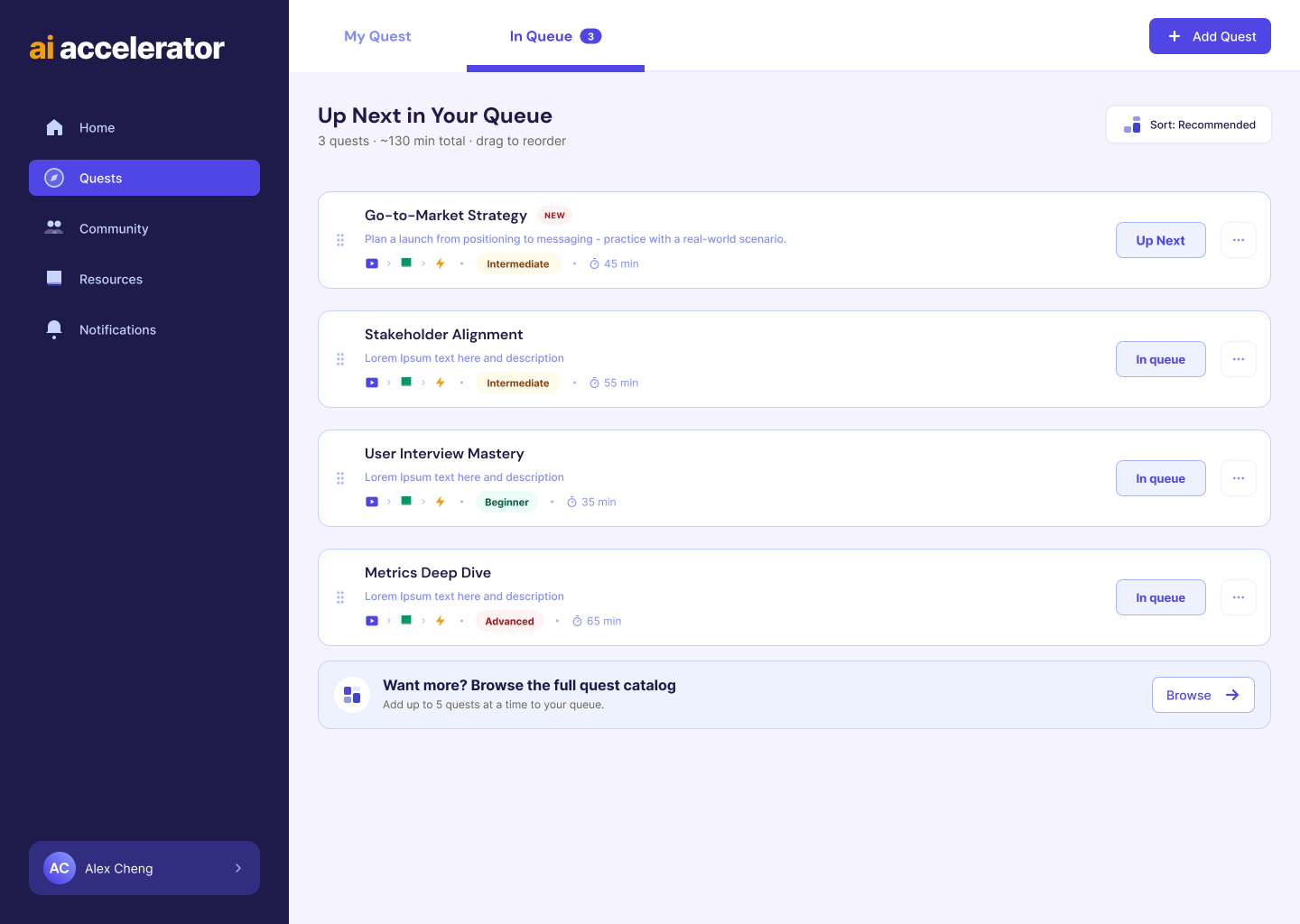
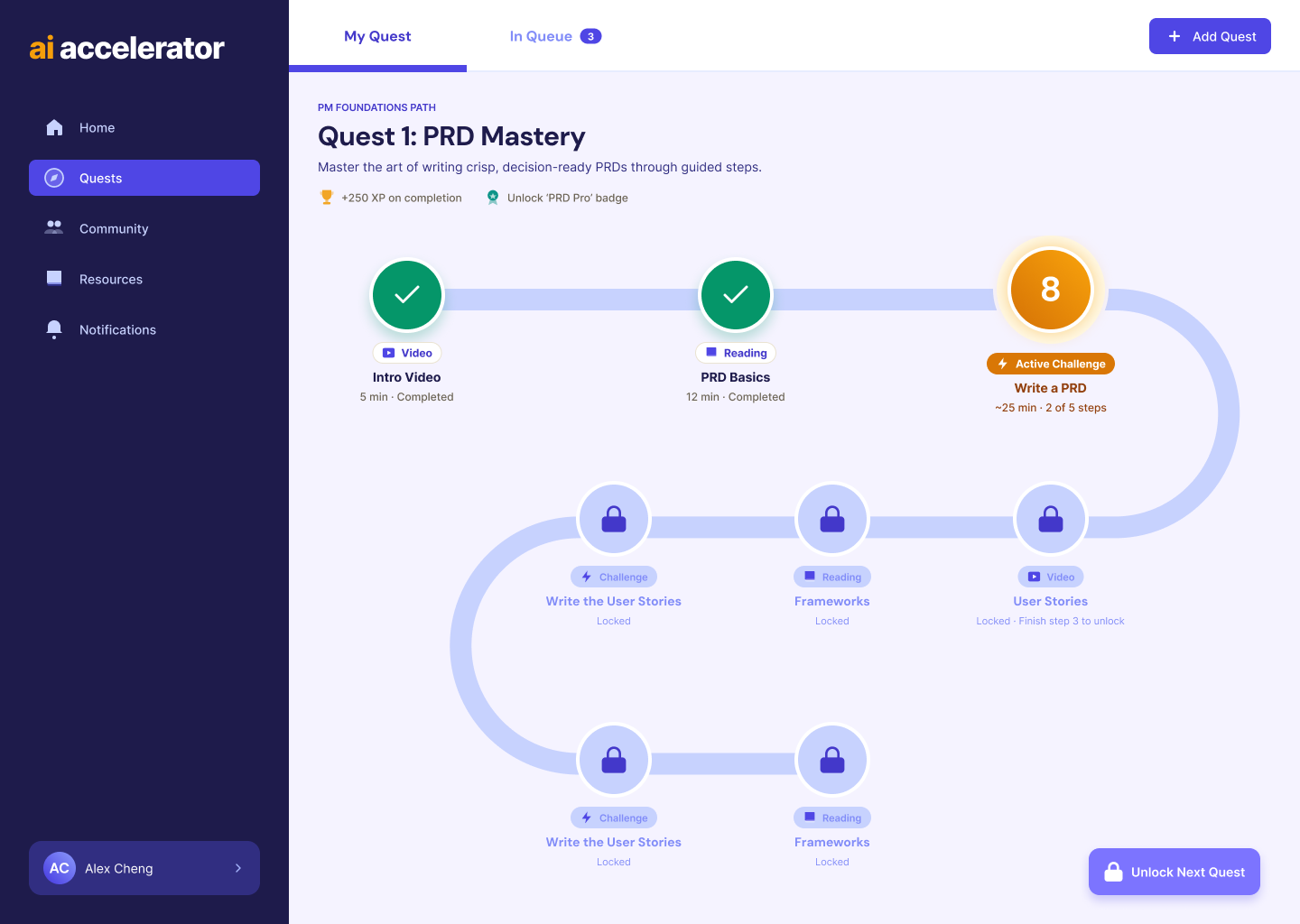
Click any feature on the left to preview its hi-fi screen. Seven screens covering the full employee loop, dashboard, queue, quest path, challenge brief, AI chat, video lesson, and the celebration moment.
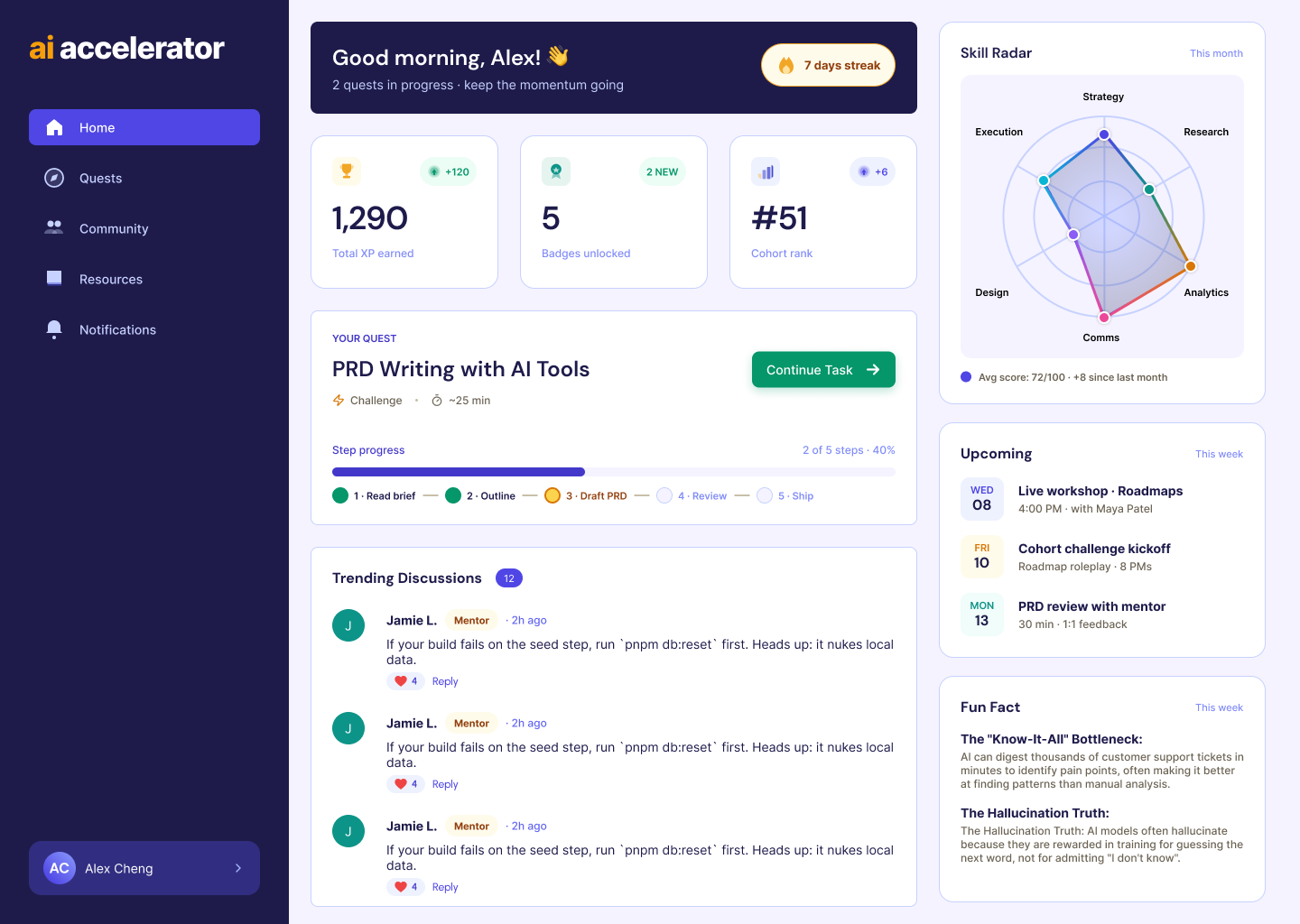
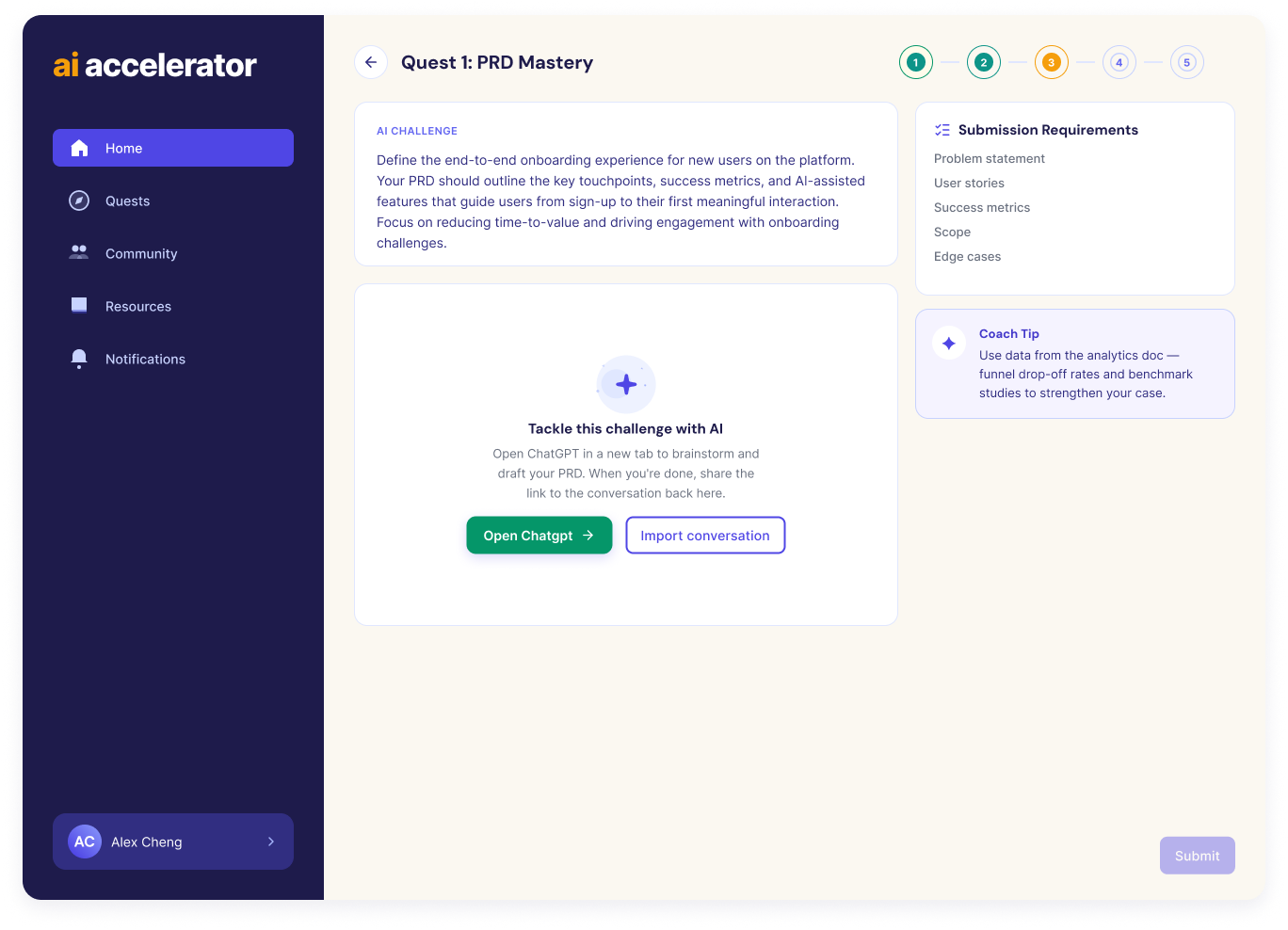
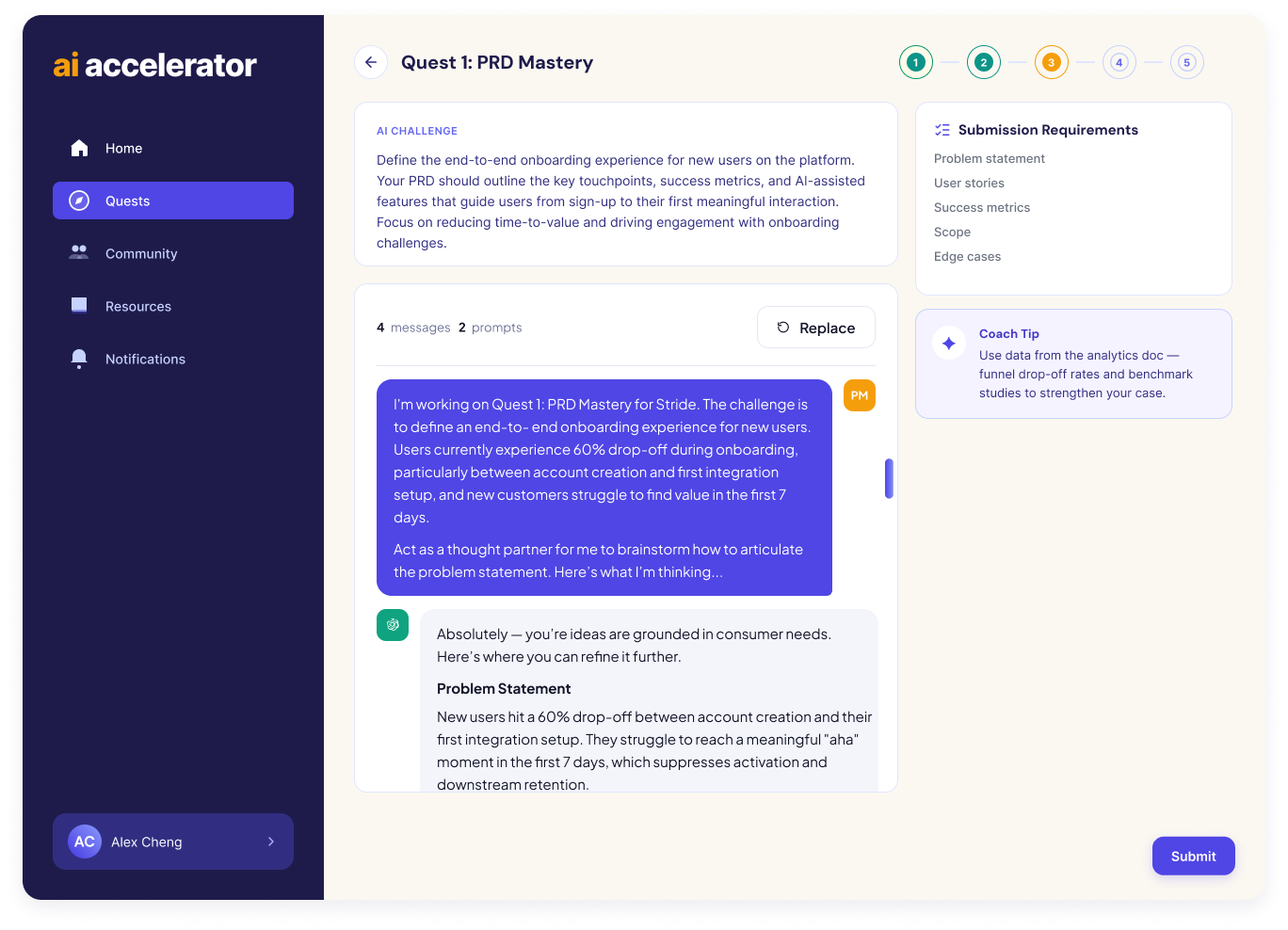
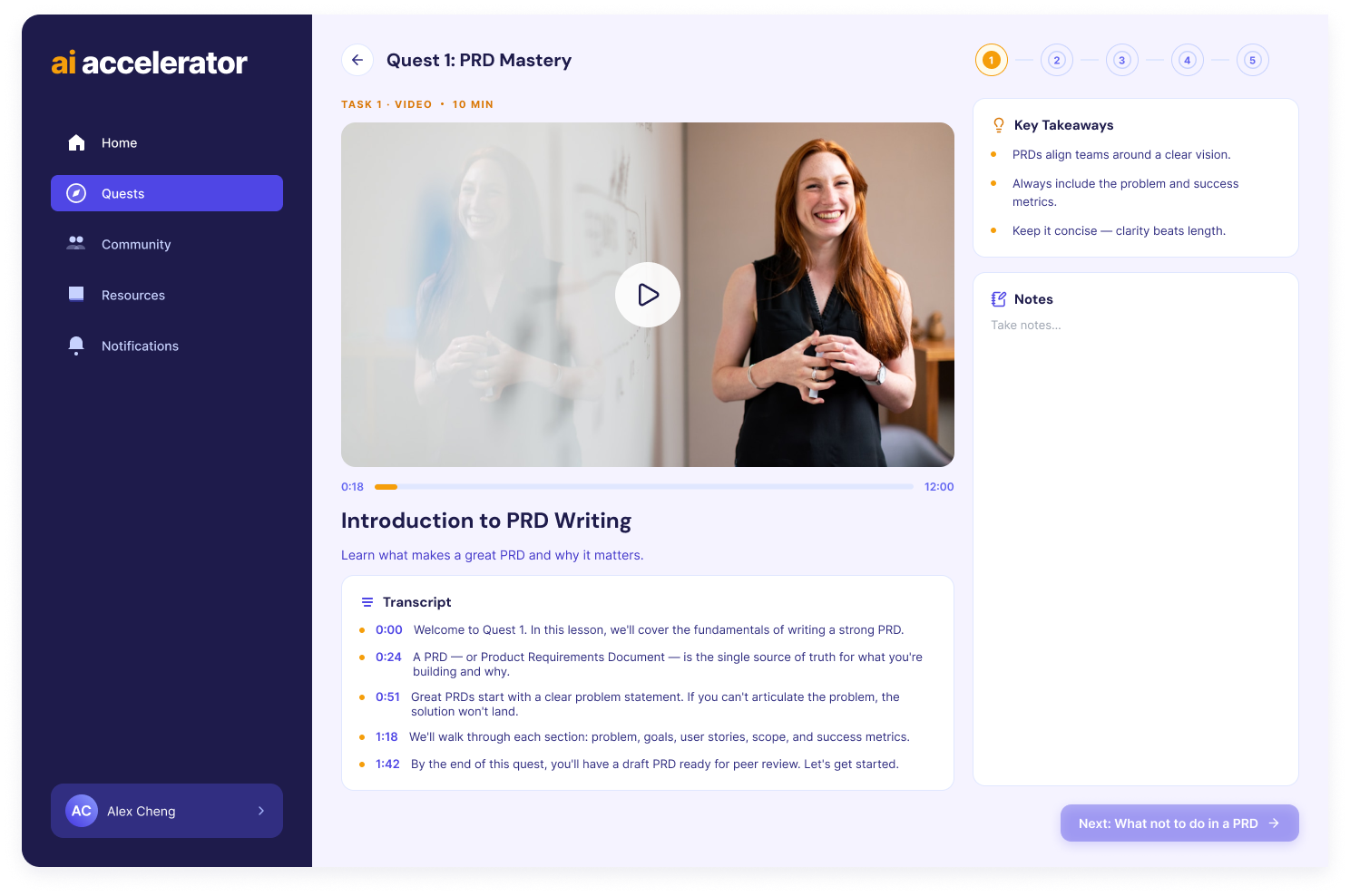
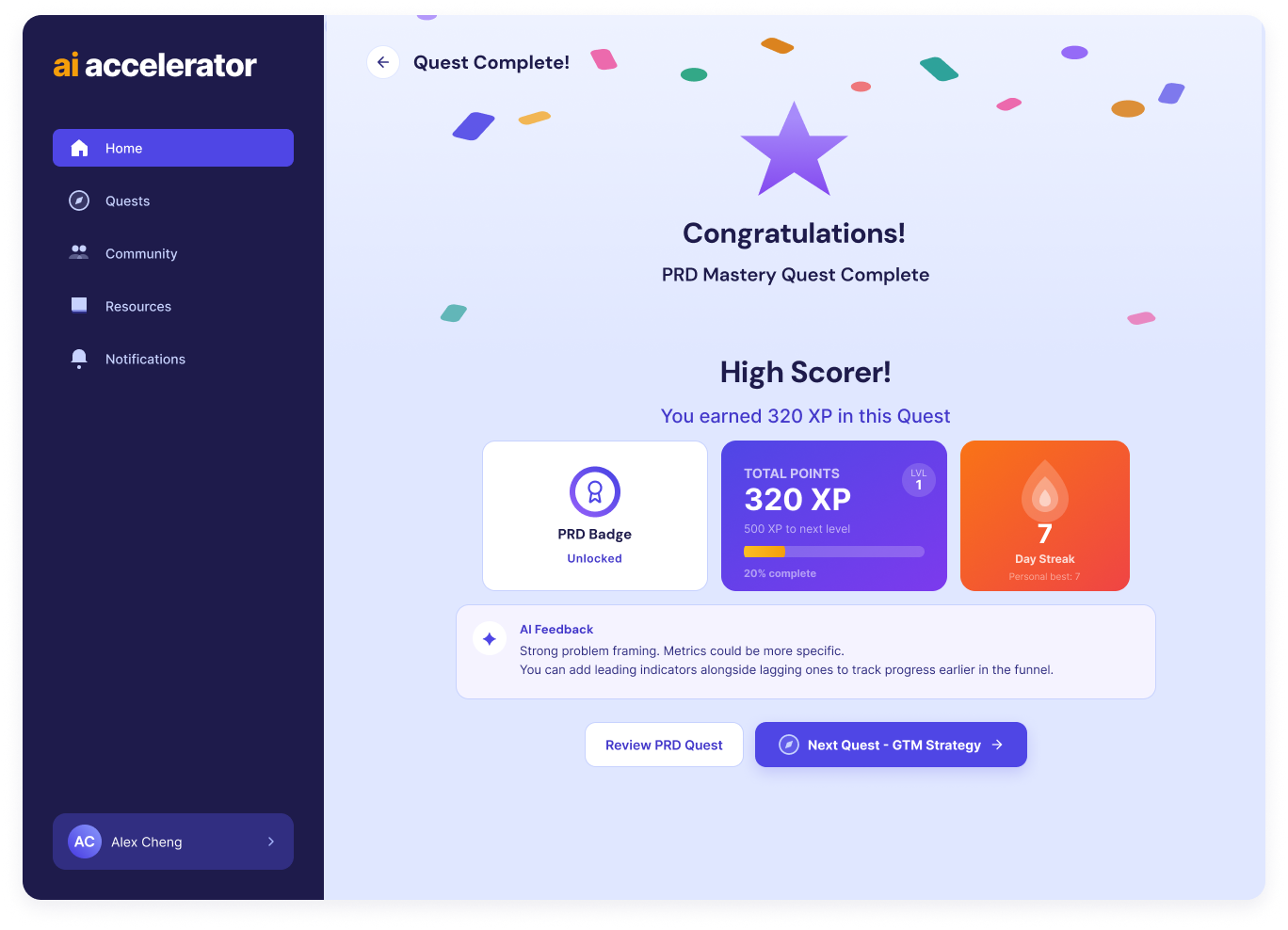
Personalized hub with active quest in the center, skill radar on the right rail, and trending peer discussions below.
Drag-to-reorder upcoming quests. The 5-quest limit prevents overwhelm while keeping a rolling commitment.
Gamified progression with locked future steps. Active challenge is highlighted, completed steps mark green.
Quest framing, submission requirements, and a coach tip in one screen. The AI challenge sets the task.
In-product AI thought partner with persistent coach tips in the right rail so flow never breaks.
Time-coded transcript synced to the video. Key takeaways and scratch notes live in the right rail.
Celebration moment with badge, XP, streak update, AI feedback summary, and next-quest prompt.
Design system
Carbon was the north star for documentation rigor and structure. AI Accelerator went token-first instead of components-first, so theming and dark mode are native from day one, not retrofitted.
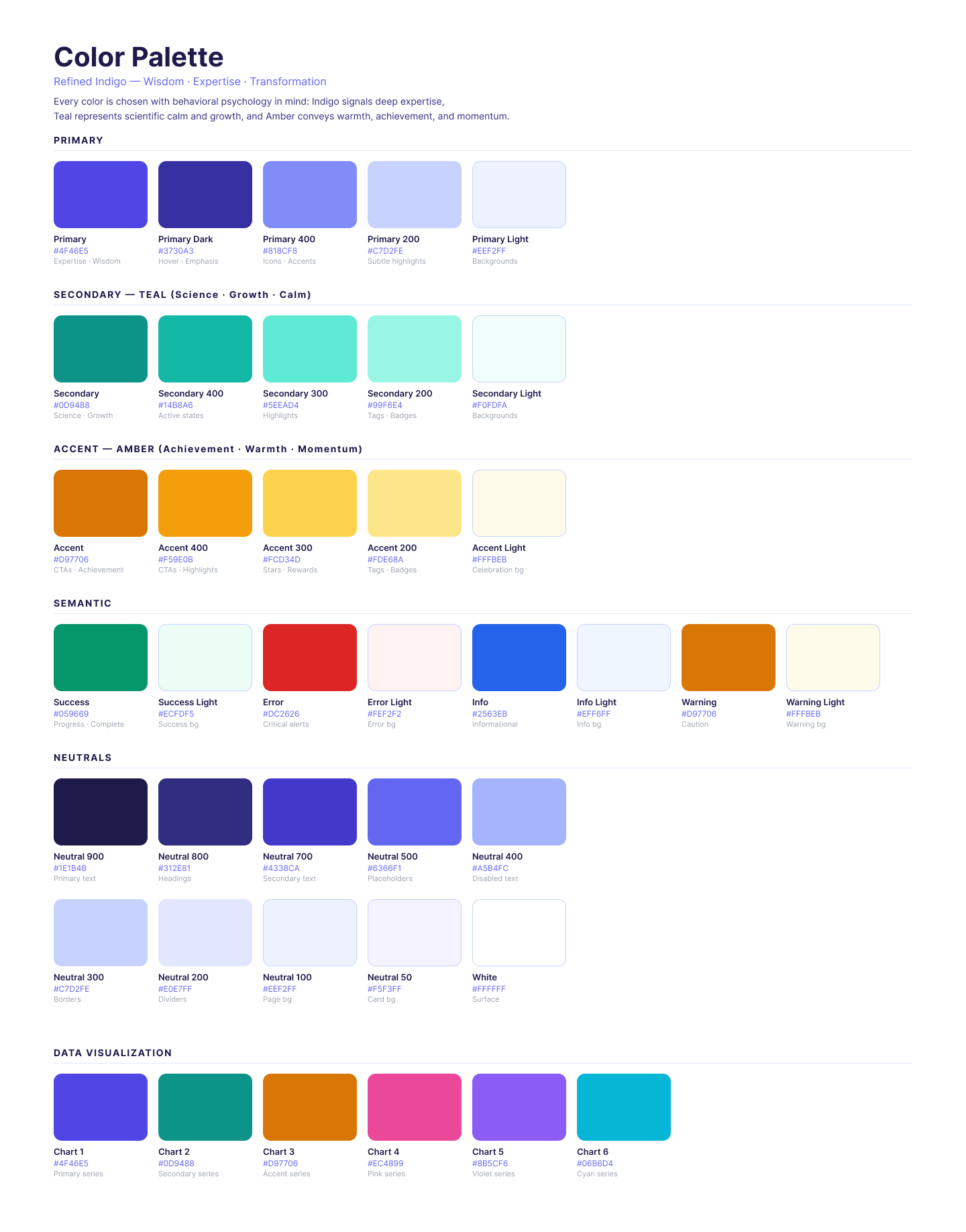
Primary indigo, secondary teal, accent amber. Every color chosen with behavioral psychology in mind.
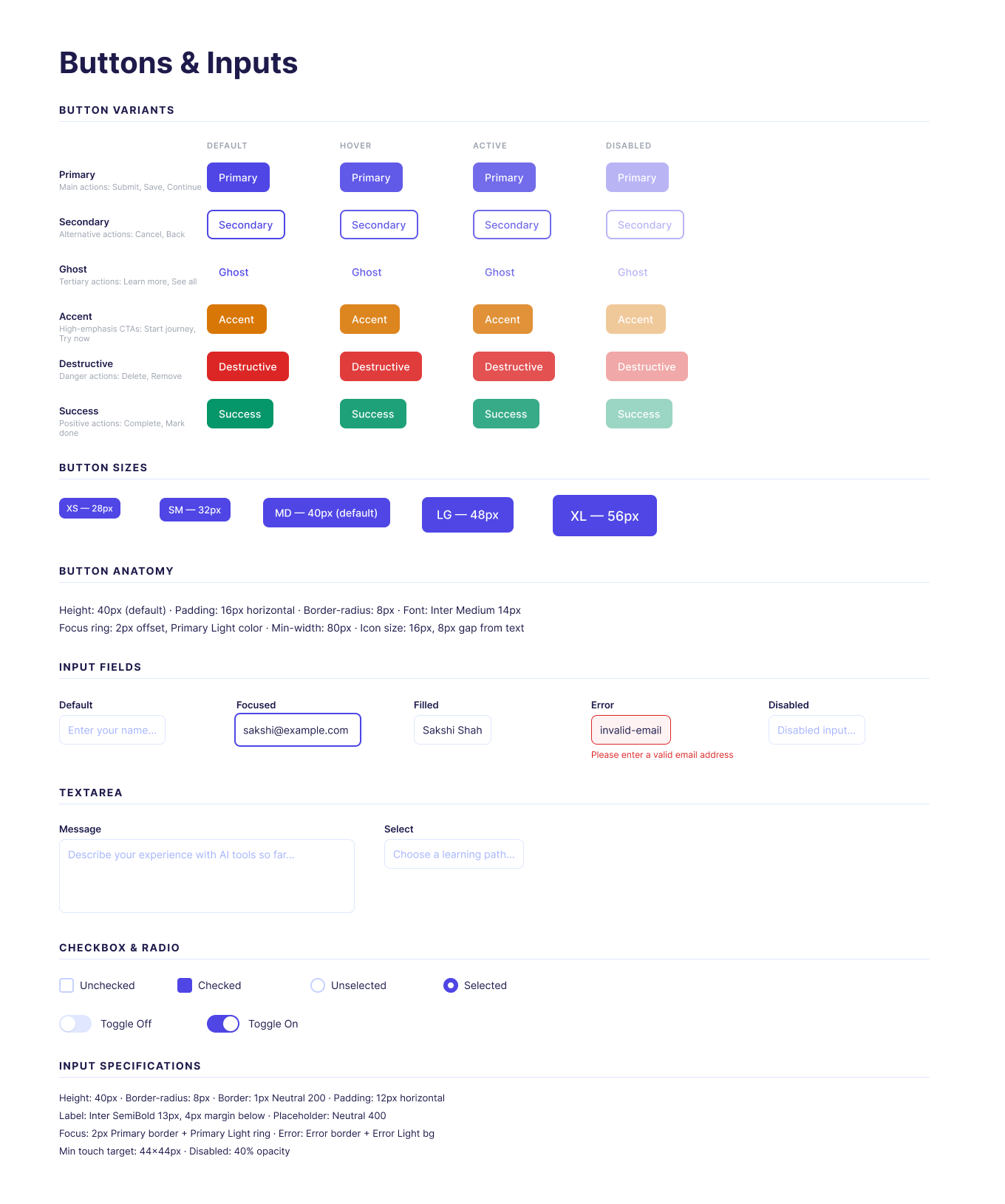
6 variants × 4 states. Full anatomy specs with tokens.
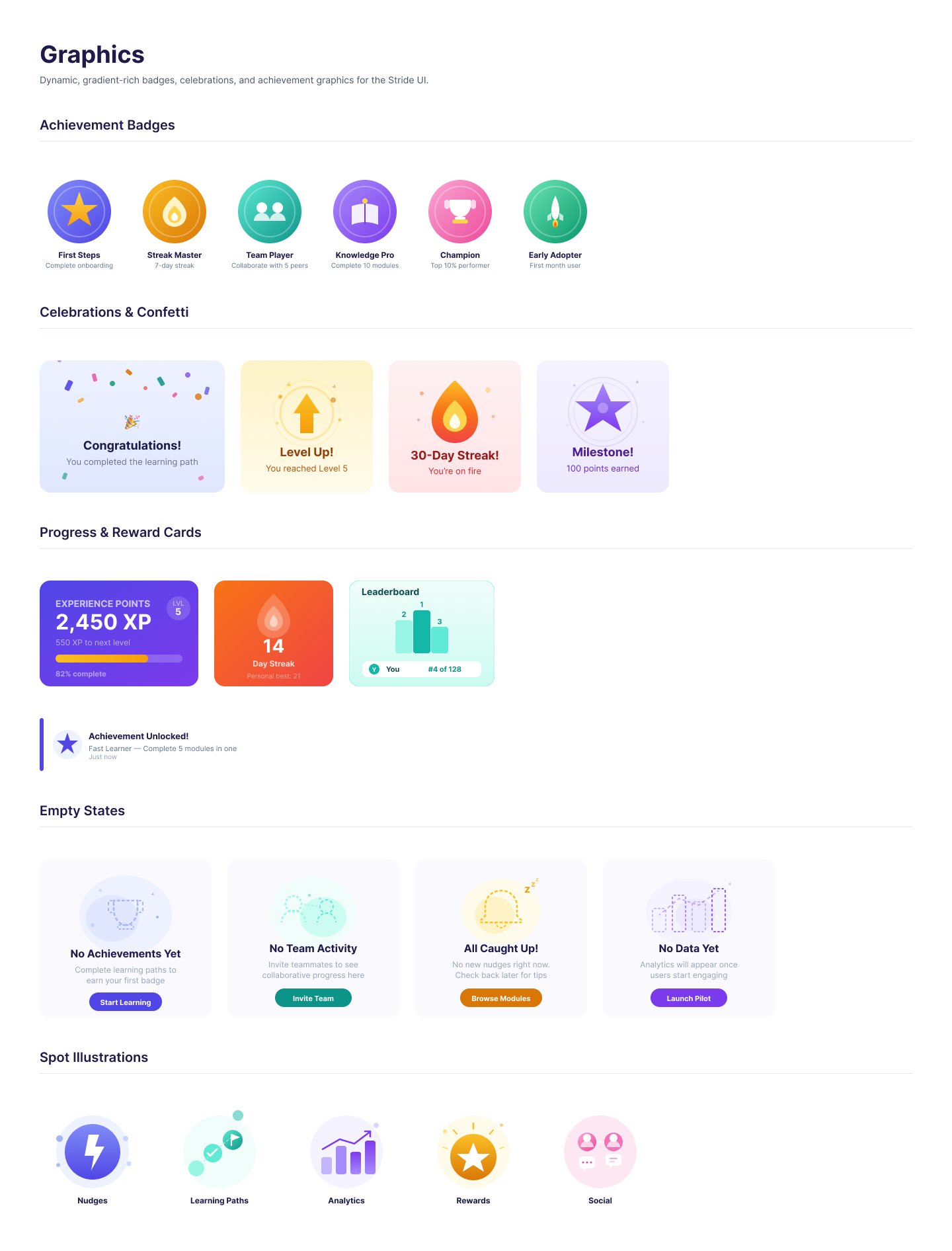
Gradient-rich badges, confetti celebrations, empty states, and persona avatars.
Two-frame documentation model
Exact token names, dimensions, spacing values, color references, CSS custom properties, and code snippets. Implement without inspecting a single node.
When to use this component vs. alternatives. Do / don't, accessibility requirements, composition rules, ARIA attributes, keyboard navigation.
Business strategy
Market sizing, willingness-to-pay validation, distribution strategy, and pilot outcomes, each product decision had a business question attached.
Global enterprise AI adoption + behavioral training market.
U.S. + Canada companies, 500+ employees, in Tech, Finance, Retail, and Healthcare actively struggling with AI adoption.
Year-2 target: 20 customers via CGI's distribution channel into enterprise clients.
Deploy first inside CGI, let CGI consultants experience the product, then use that as a credibility-earning distribution channel into CGI's enterprise clients. Internal results become external proof.
Per-seat SaaS, annual subscription. Straightforward for enterprise procurement, scalable across teams. There's a market shift toward hybrid pricing as AI usage costs swing, but the platform's value scales with human participation, not AI usage. Seat-based stays clean.
Initial hypothesis was $20/seat/month based on the landscape. Willingness-to-pay research with ~75 enterprise buyers (VPs and Heads of Product) came back at $40/seat/month. The market valued behavioral outcomes more than we'd assumed.
Value scales with human participation, not AI usage. Seat-based stays clean.
Two things make this hard to displace.
Not a feature a generic LMS vendor can ship in a sprint. The framework took years to develop and required cross-disciplinary depth in psychology, change management, and product.
Personalization compounds. The longer a customer runs the platform, the more accurate it gets and the higher the switching cost. Cohort flywheel.
The longer the platform runs, the more accurate it gets and the harder it is to displace.
The platform is for the employee, not the buyer. Every UX and brand decision flows from one line:
Make AI adoption feel human.
Not a training mandate. Not another tool IT sent. We enter the market through CGI's consulting network, earning credibility through internal results before selling externally.
The AI adoption wave won't last forever. The behavioral engine underneath the product isn't specific to AI. The same system can drive adoption for any new tool, process, or organizational change where the bottleneck is human behavior, not technology.
As the market evolves, the content changes. The core stays.
Actual impact
In enterprise training, engagement typically drops off by week two or three. The CGI sponsor pilot ran for six weeks. Engagement held through week six, validation that personalization works when it adapts to identity, not just role.
Pilot engagement curve · representative chart, original benchmark data under NDA.
Willingness to pay
Cluster analysis surfaced three distinct buyer segments with different price sensitivities and feature priorities. We mapped our pricing tiers to those segments directly. The product and design system are structured to support tier differentiation, the component library includes elements for all three tiers with gating logic built into the design patterns.
For pilot teams testing AI adoption
For organizations scaling AI adoption
For L&D leaders proving ROI
Reflection
Product design, behavioral science, change management, and organizational psychology. Pulling on any one thread pulls the others. That intersection is what made this work compound: the same year that taught me to size a market also taught me to design for the employee, not the buyer.
The numbers landed alongside the insights. 70%+ sustained user adoption in pilot. Validated $40/seat WTP across 75 enterprise buyers. A 9-month roadmap, an authored PRD, and an A/B testing system that translated user feedback into rapid iteration cycles. The platform shipped to development the week after final delivery and is advancing into production within enterprise contexts.
The moment we saw users were curious but time-constrained, every design decision got easier. Reframing this as behavioral, not training, was the most leveraged move of the project.
Problem framingPricing, market sizing, positioning all shaped what went into the product. The strategic layer wasn't a separate workstream. Every UX decision had a business question attached.
Cross-functionalNot visual or interaction-level. The hardest decisions were sequencing, scope, and what to leave out to keep the system focused on the moment of activation.
DisciplineThe product I want to be a strategist for is the one where empathy and analytical rigor are the same muscle.